Most Popular AI Art Examples
Have you ever seen a picture and thought that it was a dream? Or did you go through your feed and then think the ideal landscape you just liked was not on this planet? You are now in the realm of AI art, the world of wildness, color, and a bit of surrealism.
A few years back, computer-generated art was associated with pixelated blocks and basic geometric shapes. Nowadays, AI is bringing home blue ribbons at state fairs and fetching six figures at Christie’s. However, AI art does not mean robots taking up brushes; it means a different form of cooperation between human imagination and machine lightning. Are you a curious skeptic or digital creator wondering where your next spark will come from? We are exploring the 10 most famous AI art examples that shook the game and demonstrating how you can begin making your own masterpieces in the present.
- What Is AI Art?
- History of AI Art
- What is a Generative Adversarial Network (GAN)?
- How Does an AI Art Generator Work?
- 9 AI Art Examples!
- Traditional Art vs. AI Art
- 10 Best AI Art Tools
- How can X-Design help you in generating a masterpiece?
- AI-Powered Brand Memory
- From Text to High-Resolution Reality
- Conclusion
What Is AI Art?
AI art can also be defined as any work of art that is created with the help of artificial intelligence, at its simplest. The artist does not employ a physical brush or a digital stylus as their medium, but algorithms. The intent, the direction, and the prompts are offered by the artist, whereas the AI processes huge volumes of data to present a specific visual output. It is a combination of mathematics and vision.
History of AI Art
Although this seems to be an explosion of the 21st century, AI art traces its roots to the 1970s. It started with Harold Cohen, who developed AARON, a program that was able to draw independently by a series of complicated rules. The DeepDream created by Google in the 2010s opened the door to the psychedelic aspect of neural networks. As early as 2022, the profession of a creator democratized, and any person who has access to a keyboard can create something with the help of such tools as Midjourney, X-Design, and Stable Diffusion.
What is a Generative Adversarial Network (GAN)?
Most of the famous AI art of 2014-2020 was created using the assistance of GANs. Suppose a GAN is a competition of art in which there are two neural networks to be won:
The Generator: This network attempts to generate an image.
The Discriminator: This network examines the image and tries to juxtapose it against what can be considered real art. They alternately work on the Generator in an attempt to fool the Discriminator until it becomes so realistic that it cannot be recognized as made by a human hand.
How Does an AI Art Generator Work?
Modern generators mostly use a process called diffusion. Imagine taking a clear photograph and slowly adding static (noise) until it’s just a gray blur. That’s "Forward Diffusion." AI art generators work in reverse. They begin with a field of random noise, and, as you suggest in your text, they denoise the image pixel by pixel.
9 AI Art Examples!
1. Edmond de Belamy (2018)
Developer: Hugo Caselles-Dupré, Pierre Fautrel et Gauthier Vernier.
AI Tool: GAN implemented by artist Robbie Barrat.
The Process:
Input: The model was trained using 15,000 portraits, which were painted between the 14th and 20th centuries.
Finishing Touch: The collective made a print of the image on canvas and signed it using the mathematical formula of the algorithm they used.
Impact: Auctioned by Christie’s and sold to the highest bidder at $432,500. It was the first assessment of AI art to be sold in the high-end art market.
2. The Next Rembrandt (2016)
Developer: Microsoft, ING, TU Delft, and The Rembrandt House Museum.
AI Tool: Face recognition and custom deep learning algorithms.
The Process:
Analysis: The AI analyzed 346 original Rembrandt paintings in terms of texture, brushstrokes, and geometry.
Generation: It was tasked to create a "new" portrait of a 30-40-year-old Caucasian male with facial hair, wearing black clothes and a hat.
Physicality: To mimic the master's hand, the work was 3D printed with 13 layers of UV ink to match the physical height of Rembrandt's actual paint thickness.
Impact: These shocking results proved that the AI could not just imitate the style. It could also touch and feel the physical texture and spirit of a historical master.
3. Refik Anadol: Unsupervised (2022)
Developer: Refik Anadol.
AI Tool: Custom GANs and high-performance computing by NVIDIA.
The Process:
The Archive: Anadol used a machine-learning model to process metadata and images of 138,151 artworks from the MoMA collection.
Real-Time Flux: The installation is "live." It uses sensors in the museum to track noise, light, and movement, which causes the AI to constantly shift and "hallucinate" the collection's colors and shapes on a massive screen.
Impact: It transformed MoMA's lobby into a living digital organism. This becomes one of the most famous examples of data-driven installation art.
4. Harold Cohen: AARON (1973–2016)
Developer: Harold Cohen.
AI Tool: AARON (symbolic rule-based AI, written in Lisp and C).
The Process:
Knowledge-Based: Cohen did not feed AARON rules on physical reality the way a modern AI learns, but instead taught AARON rules. For example, how bodies bend, how plants grow, and how color combinations work together to produce pleasing effects.
Physical Execution: For years, AARON controlled physical plotters (robotic arms) that held pens or brushes to draw on paper. Later, it was programmed to "paint" digitally.
Impact: AARON is the most historic AI project that has ever been created because it shows that AI art did not start with the internet.
5. The Butcher’s Son (2017)
Developer: Ahmed Elgammal and Mario Klingemann.
AI Tool: AICAN (Artistic Creative Adversarial Network).
The Process:
Deviation Rule: The AICAN algorithm was programmed to learn from 80,000 images but was specifically coded to maximize "stylistic ambiguity."
Aesthetic Search: It was created to discover a middle ground at which the image is perceived as art but does not belong to any known human movement (Impressionism or Cubism).
Impact: Winner of the Bolt Art Prize and proved that AI could be applied to move beyond human history toward completely new aesthetics.
6. Drawing with L.I.N.A.S. (2019)
Developer: Sougwen Chung.
AI Tool: Custom neural networks and a robotic arm (L.I.N.A.S.).
The Process:
Training on Self: Chung trained the AI on her own past sketches and movements.
The Duet: In a live show, the sensors trace the live brushstrokes of Chung. The AI robot reads the actions she takes and reacts in real-time on the same screen.
Impact: The emphasis on the process of collaboration instead of the finished image, displaying AI as a continuation of the body of the artist, but not as a substitute.
7. Memories of Passersby I (2019)
Developer: Mario Klingemann (German artist and the father of neural art).
AI Tool: A group of GANs on a computer brain designed and built.
The Process:
The Hardware: It is a physical installation, as opposed to most AI art, which runs on a server. It has an antique-style chestnut wood cabinet, which contains AI hardware, and it is connected to two high-definition displays.
Impact: The first self-contained, self-programmable artificial intelligence machine made a sale at a large auction (Sotheby's). This no longer made the image the work but the system instead.
8. DeepDream (2015)
Developers: Alexander Mordvintsev, Christopher Olah, and Mike Tyka.
AI Tool: Convolutional neural network and ImageNet.
The Process:
Algorithmic Pareidolia: A neural network will usually be trained to detect objects (e.g., "Is it a dog?). Mordvintsev decided to go backwards with the network.
The Technique: He gave the network an image and instructed it, "Whatever you see in here, improve it. When a cloud appeared a little bit like a bird, the network would turn the pixels to resemble a bird closely. The image would become a psychedelic landscape with surrealistic elements after hundreds of repeats.
The "Dogs": Because the original dataset (ImageNet) was heavily weighted with images of dogs and cats, the early DeepDream images were famously filled with "puppy-slugs" and multi-eyed animals.
Impact: It was the first time the general public saw the "inner thoughts" of an AI. It launched the first major wave of AI art and was open-sourced, allowing millions to create their own "trippy" visuals.
9. Holly+ (2021)
Developers: Holly Herndon and Mat Dryhurst.
AI Tool: Personal timbre transfer models and a decentralized autonomous organization (DAO).
The Process:
The Digital Twin: Herndon created a high-fidelity AI model of her own voice. This "vocal twin" can take any incoming audio (someone else singing, a violin, or even a whistling noise) and "re-render" it as Holly Herndon’s voice.
Identity Play: Herndon made the tool available online, allowing anyone to "spawn" music using her voice.
The DAO Governance: To handle the ethics of deepfakes, the project is governed by a DAO. If someone creates a song using her AI voice, the community votes on whether it is an official "Holly+" work. Profits are split: 50% to the creator, 40% to the DAO, and 10% to Holly herself.
Why It Matters: It is the "gold standard" for ethical AI. Rather than oppose AI mimicry, Herndon developed a roadmap of how artists can possess, license, and cooperate with their online individualities.
Traditional Art vs. AI Art
Traditional Art | AI Art |
It is created by human hands through skill, experience, and practice. | It is generated by algorithms using data and prompts. |
It takes time and process. | It is created effectively and quickly. |
Traditional art is deeply personal and emotional. | AI Art depends on training data and prompts. |
For beginners, it requires training. | This art is more accessible to anyone. |
This art is rooted in human imagination. | This art expands through experimentation. |
10 Best AI Art Tools
Midjorney
DALL·E 3
Stable Diffusion
Adobe Firefly
Leonardo.ai
Canva AI
X-Design
NightCafe Studio
Ideogram
Artbreeder
How can X-Design help you in generating a masterpiece?
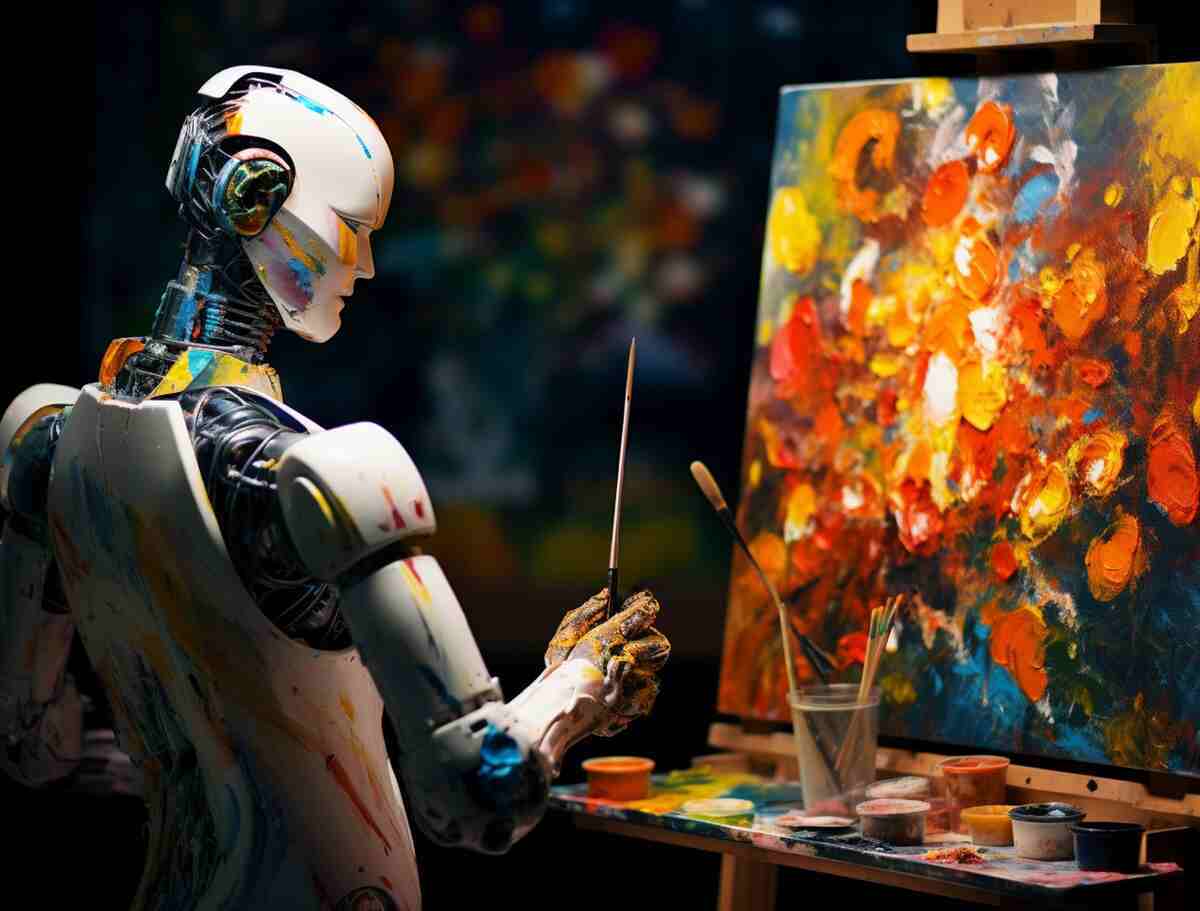
Professional-level art does not need a PhD in computer science to create. X-Design is the interface between the complicated algorithms and sheer inspiration. Whether you are building a brand or just exploring your inner Picasso, X-Design acts as your "Creative AI Agent."
AI-Powered Brand Memory
Stop starting from scratch. X-Design takes the visual identity of your brand, including colors, logos, and fonts, and uses them throughout all pieces created by AI. It is art that really resembles you.
From Text to High-Resolution Reality
You can create classic oil paintings or design high-tech 3D figurines with the sophisticated text-to-image engine of X-Design. On top of this, you have the aspect ratios and style fine-tuning that guarantee that your masterpiece will fit all platforms.
Are you willing to make your vision come true? Do not follow the AI revolution, but shape it. Try X-Design for free today!
Conclusion
From the rule-based scribbles of the 70s to the breathtaking, fluid installations of today, AI art has proven that technology doesn't kill creativity—it expands it. We’ve seen how algorithms can resurrect the style of Rembrandt and how human-robot "duets" can redefine the act of painting.
The most exciting part? The "Greatest AI Art Example" has not been created as of now because you have not created it. Must try X-Design and create a history!